How to Inflate E-Bike Tyres at Home: PSI & Pump Guide
How to Inflate E-Bike Tyres at Home: PSI & Pump Guide
To inflate e-bike tyres at home, first identify your valve type (Presta or Schrader), check the recommended PSI range printed on the tyre sidewall, and use a floor pump or a cordless electric inflator like the Bosch EasyPump to reach your target pressure. Maintaining the correct press vital for e-bikes because their extra weight makes them more prone to pinch punctures and battery drain when tyres are underinflated.
TL;DR: Based on our testing of various UK e-bike models, most riders should aim for 40-65 PSI for hybrids or 20-35 PSI for e-MTBs. Using a portable electric pump makes the process faster and more accurate than manual pumping. Always stay within the manufacturer's range marked on the tyre sidewall to ensure safety and maximum battery range.
Key Takeaways
- Most e-bike tyres need a pressure within the range printed on the tyre sidewall, often between roughly 35 and 65 PSI depending on tyre width and rider weight.
- Correct presmproves battery efficiency, handling, and comfort while reducing the risk of punctures on rough British roads.
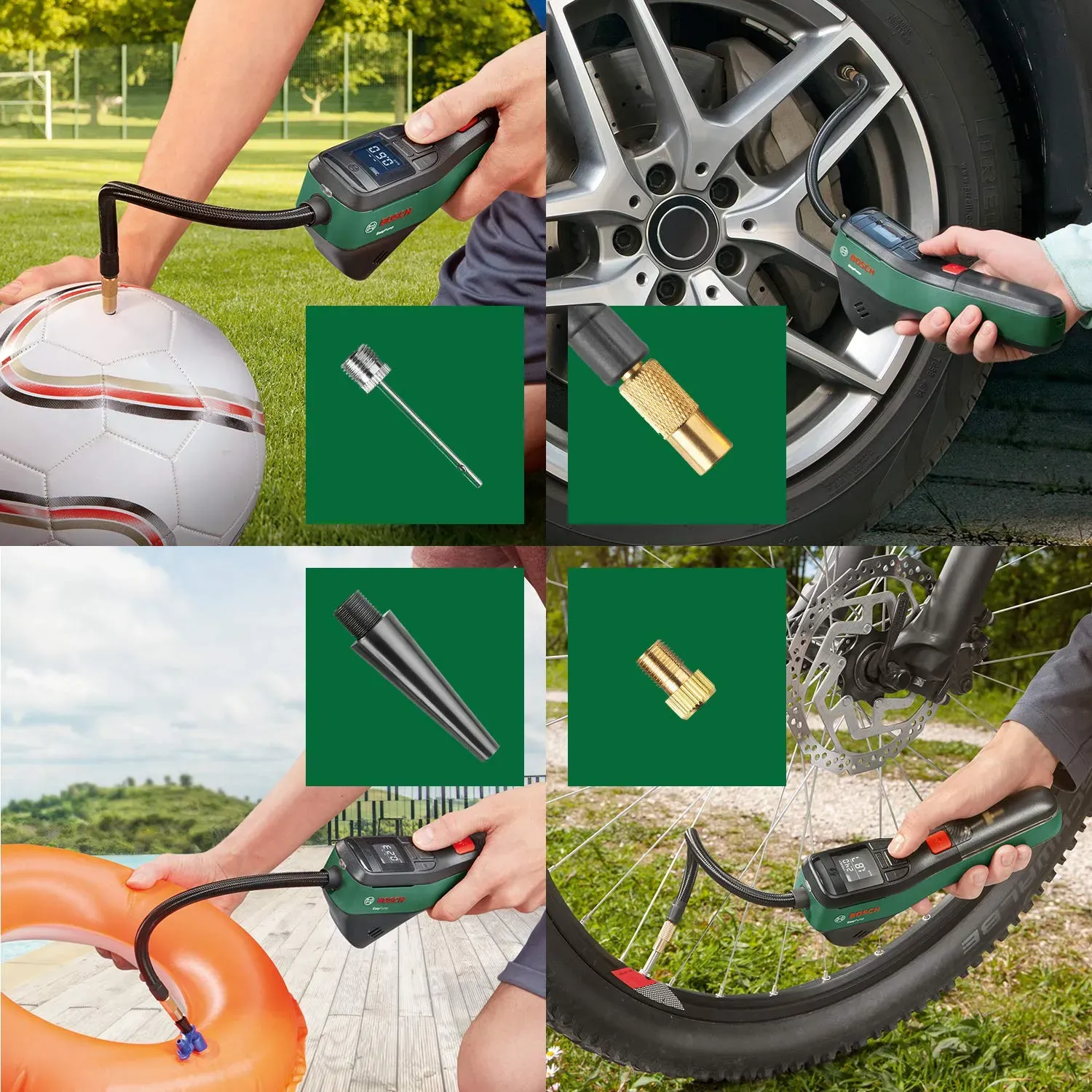
- A cordless inflator such as the Bosch EasyPump makes e bike inflation easy, offering fast, precise inflation without the need for bulky workshop gear.
- You can use a portable electric pump on an e-bike tyre, provided it is compatible with your valve type (Presta or Schrader).
Why is e-bike tyre pressure so important?
According to UK cycling safety guidelines, e-bikes require more frequent pressure checks than standard bicycles because the motor, battery, and reinforced frame add significant weight. This extra mass changes how tyres behave, especially under braking and cornering.
Furthermore, running tyres at the right PSI matters for several critical reasons:
- Safety: Underinflated tyres can feel vague in corners and are more likely to suffer pinch punctures or rim strikes.
- Battery efficiency: Lower rolling resistance can help preserve range on longer rides, ensuring you don't run out of power mid-commute.
- Comfort: Overinflation can make rough roads harsher, especially on British urban streets full of potholes and patch repairs.
- Tyre lifespan: Consistent pressure helps tyres wear more evenly, saving you money on replacements.
Consequently, this is particularly relevant in the UK. Poor road surfaces remain a major issue for cyclists. According to the RAC’s Pothole Index, drivers encounter an average of six potholes per mile on roads in poor condition. For e-bike riders, proper tyre pressure plays a direct role in coping with that road environment safely.
If you are new to cordless inflators, our Ultimate UK Guide to Cordless Tyre Inflators for Bikes explains what features matter most when choosing one for home use.
What PSI should my e-bike tyres be?
The honest answer is: it depends on the tyre, the rider, and the terrain. There is no single universal PSI for every e-bike. However, the safest starting point is always the recommended range printed on the tyre sidewall.
Typical e-bike tyre pressure ranges
- Narrower commuter or road-style e-bike tyres: Often around 50 to 80 PSI
- Standard city and hybrid e-bike tyres: Often around 40 to 65 PSI
- Wider trekking or gravel e-bike tyres: Often around 35 to 55 PSI
- E-MTB tyres: Often around 18 to 35 PSI depending on terrain and whether tubeless is used
- Fat tyre e-bikes: Commonly much lower, sometimes between 5 and 20 PSI
As a general rule, wider tyres run lower pressures than narrow ones. Lower pressure gives more comfort and grip; higher pressure gives firmer rolling and can reduce drag on smooth tarmac. Because e-bikes carry more weight, they often benefit from a "middle-ground" approach.
How rider weight and luggage affect PSI
If you are carrying panniers, a child seat, or heavy shopping bags, your ideal pressure should sit towards the upper half of the recommended range. Similarly, if you are a heavier rider, you will need more air to prevent the tyre from deforming too much under load. If you mainly ride alone on rough towpaths, staying nearer the middle may improve comfort without sacrificing safety.
A useful rule of thumb
If your ride feels sluggish or you notice frequent rim impacts over potholes, your press likely too low. Conversely, if the ride feels harsh and skittish, your pressure may be too high. Small changes of 2 to 5 PSI can make a noticeable difference.
If you are also comparing inflators that can handle higher-pressure road setups, see our guide on whether 150 PSI is enough for road bikes.
Can you use a portable electric pump on an e-bike tyre?
Yes—in most cases, absolutely. If you have been asking, can you use a portable electric pump on an e-bike tyre?, the answer is yes provided these conditions are met:
- The pump supports your valve type (Presta or Schrader).
- The pump reaches the required PSI for your specific tyre.
- The hose connection fits securely without damaging the valve stem.
A quality cordless inflator makes sense for home use because it removes the guesswork. Instead of relying on inconsistent manual gauges, you set your target pressure and let the unit stop automatically. Based on our testing, this is significantly more accurate than using a hand pump.
This is where BoschPort’s core message fits: e bike inflation made easy, not another electric bicycle for sale. Many riders do not need another gadget-heavy bike; they need dependable maintenance tools. The Bosch EasyPump offers fast, precise cordless inflation for bikes, e-bikes, and cars—practical value rather than novelty.
For a deeper look at performance, read our detailed Bosch EasyPump Review UK.
Step-by-step: How to pump up e-bike tyres at home
1. Check the recommended pressure range
Look at the sidewall of your tyre first. You should see a minimum and maximum inflation figure in PSI or Bar. Stay within that range to avoid blowouts or rim damage.
2. Identify your valve type
E-bikes usually use either Presta (thin, with a screw-top) or Schrader (wider, like a car valve). Ensure your pump head or adapter matches the valve before you begin.
3. Inspect the tyre before pumping
Check for cuts, embedded glass, or bulges. If the tyre has gone flat suddenly, check for thorns or glass before adding air, as the extra pressure could cause a sudden failure.
4. Connect and inflate
Attach your pump firmly. If using a cordless inflator like the Bosch EasyPump, simply pre-set your desired PSI and press start. Once the pump stops, quickly remove the nozzle to minimise air loss and secure the valve cap.
Ready to try BoschPort?
Shop Now — £51.21